
Your needs, this model
Does it fit your priorities?
Can the CM2046S make an ahead-of-time 12-cup thermal pot with stronger-brew option?
Yes. The exact manual describes a 24-hour Brew Later start, a 12-cup/60-ounce thermal carafe and Regular/Strong selection in one grounds-only operating plan.
Explore this need in the finder →Does its 12-cup label mean twelve large mugs?
No. The manual defines a maker cup as about five fluid ounces and says the carafe holds 60 ounces total; it is a batch pot, not twelve standard 8-ounce servings.
Explore this need in the finder →Can I require a reusable permanent carafe filter with this exact package?
No permanent reusable filter is listed; the manual calls for a basket-shaped paper filter inside the washable brew basket. If a permanent filter is essential, use the filter-included requirement and compare confirmed alternatives.
Explore this need in the finder →Can I get an actual dedicated 1–4 cup control?
The manual recommends Strong for fewer than four cups and prewarming the thermal carafe for half a pot or less, but it does not document a dedicated 1–4-cup setting.
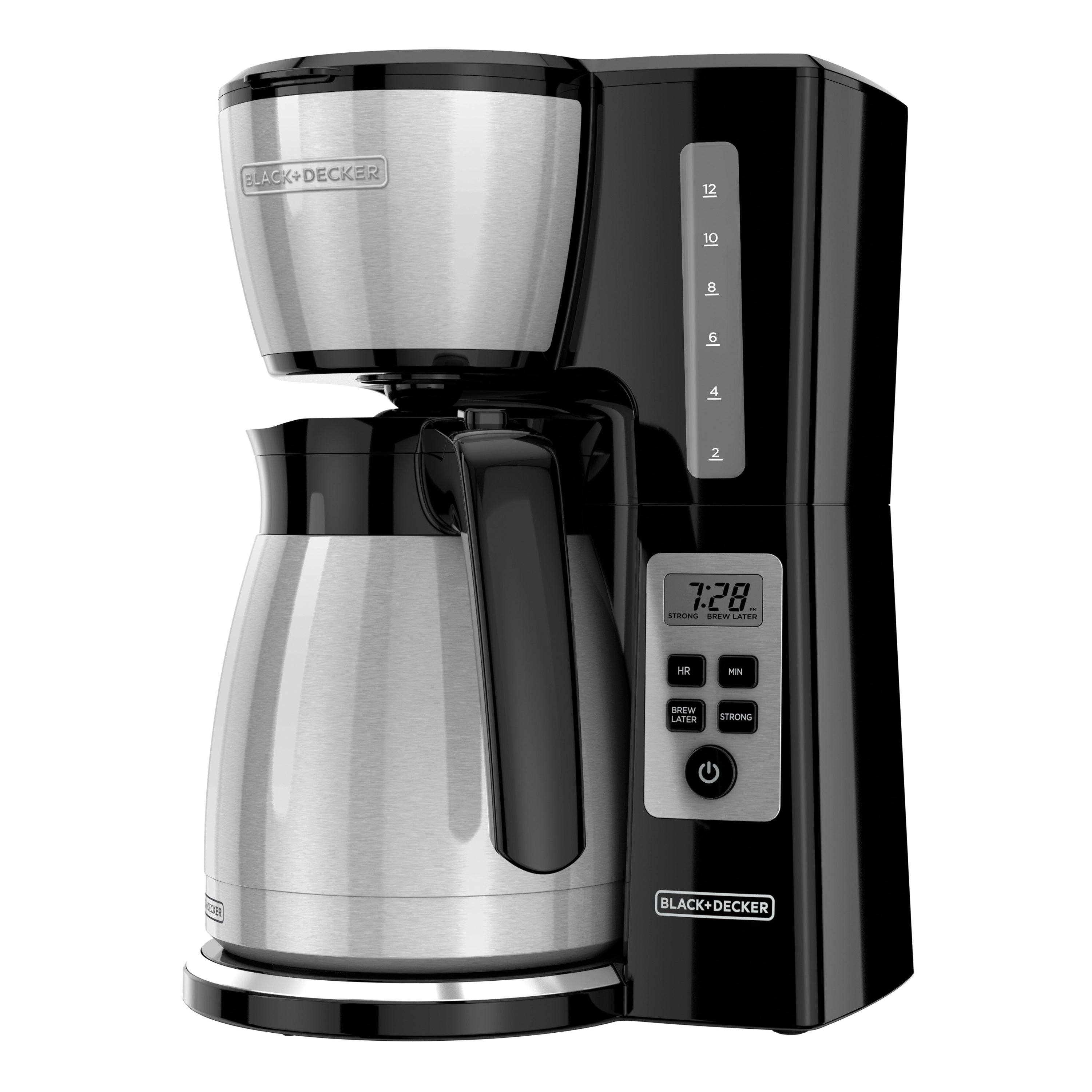
Explore this need in the finder →The BLACK+DECKER CM2046S is a conventional batch brewer with one important serving difference from the usual glass-pot model: its stainless-steel carafe is insulated rather than sitting on an active warming plate. It also adds a delayed start, a Regular/Strong choice and a quick-pour interruption. Those choices suit a household that fills a pot before the morning rush and wants it to remain available without keeping a heater on underneath.
Think in five-ounce maker cups, not large mugs
BLACK+DECKER calls this a 12-cup coffee maker, but the use-and-care manual defines one of its cups as about five fluid ounces. It says the thermal carafe holds 12 of those cups, or 60 ounces. That is useful for a family pot, but it is not the same as twelve eight-ounce travel mugs. If your essential need is a minimum number of full-size servings, use the exact ounce line rather than reading “12 cup” as a household mug count.
The manual’s starting ratio is one tablespoon of ground coffee per maker cup. You load fresh cold water to the visible line, put a basket-shaped paper filter in the washable basket, add grounds and place the empty carafe on its seat. There is a Strong setting, but it works by slowing the brew process; this is not a separate small-batch control or a programmable temperature adjustment. The manual specifically recommends Strong when making fewer than four cups. It also recommends warming the thermal pot first when brewing half a carafe or less, a helpful detail for a two-person breakfast but an extra step that a glass carafe on a plate does not require.
Programmable does not mean complicated
Brew Later sets a 24-hour delay start, so the useful routine is to load water, filter and grounds in the evening, set the clock and start time, then let the brewer begin on its own. A power interruption means resetting both the clock and the delayed start. There is no app or connected schedule documented. After a cycle, the fresh-brew display counts down from 120 minutes; treat that display as an elapsed-time reminder, not as an active heat setting. The brewer shuts itself off at the end of brewing. The insulated pot, not a plate, is what retains heat. BLACK+DECKER claims up to two hours of temperature maintenance, but this is a maker statement, not an independent temperature test.
Sneak-A-Cup temporarily stops the flow so you can pour before the pot is done. The manual is precise about the limit: return the carafe within 20 seconds to avoid the basket overflowing. That is a brief pause for an impatient first cup, not a long pause-and-serve function. When pouring, use the button on the carafe handle and keep the lid fitted correctly; the manual warns against tilting the pot backward.
Know the filter and cleanup routine
The exact product listing includes a removable, washable brew basket. Its manual instructs the owner to place a basket-shaped paper filter in that basket and later discard the paper with the grounds. The package list does not identify a permanent reusable mesh filter, so do not choose this model on the assumption that you can skip paper. If a reusable filter is essential, a documented alternative such as the Cuisinart DCC-3400NAS includes a permanent Gold-Tone filter; compare its exact fit, controls and ownership routine rather than assuming all thermal carafes arrive with the same filter.
The washable basket and carafe are hand-washed in warm soapy water, and the housing, cord and carafe seat are wiped with a damp cloth. The automatic cleaning reminder appears after 60 brew cycles or when the machine senses mineral buildup. The maker’s vinegar descaling routine takes 45–60 minutes, including a pause, then requires a fresh-water flush. That maintenance is more involved than rinsing a cup, but the prompt helps make descaling visible instead of leaving the owner to guess.
Who should consider it
The CM2046S fits a household that wants one grounds-only pot, a timer for tomorrow’s first brew, an insulated carafe and a selectable stronger cycle. The listed footprint is 13.2 inches high, 9 inches long and 9.4 inches wide; allow more clearance to open the lid and lift out the basket. Its listed weight is 12.1 pounds, so this is not a tiny unit meant to move between cupboards each day.
Choose another format if you need single-serve pods, a built-in grinder, a separate hot-water outlet, a permanent filter, an active warming plate or a documented small-batch mode. This model’s “12-cup” claim is in the maker’s small five-ounce units, and the manual’s small-pot advice is to use Strong and prewarm the carafe. The product page uses inconsistent wording for the thermal carafe’s layer count, so that number is not a sound comparison point; the practical supported distinction is simply insulated pot versus hot plate. I have not independently measured brew temperature, flavor, speed or heat retention. The best fit is therefore the routine, not an unverified taste promise.
Key details at a glance
| Coffee formats | grounds |
|---|---|
| Brew styles | standard |
| Integrated coffee grinder | No |
| Pod serving size or maximum | oz |
| Finished-coffee serving vessel | Separate carafe |
| Carafe capacity | 12 cups |
| Carafe | Vacuum-insulated thermal carafe |
| How a finished batch stays warm | Vacuum insulation; no warming plate |
| Permanent coffee filter included | No |
| Adjustable warming-plate temperature | No |
| Bold/Regular strength control | Yes |
| Dedicated 1–4 cup batch setting | No |
| Single-serve grounds cup included | No |
| Removable reservoir | 60 oz |
| Separate hot-water route | No |
| Manual steam wand | No |
| Milk-frothing tool included | No |
| Milk-frothing tool heats milk | No |
| Electrical input | 750 W |
| Voltage | 120 V |
| Drip-side water reservoir | 60 oz |
| Documented single-cup servings or maximums | oz |
| Cold Brew with grounds | No |
| Over Ice with pods | No |
| Single-serve grounds sizes | oz |
| Strength-control choices | 2 settings |
Use the exact model’s instructions for operating limits, supplied equipment and version differences.
Sources for this assessment

Match the carafe to your coffee routine.
Choose between a warming plate and an insulated pot, then check what the exact box includes.