
Your needs, this model
Does it fit your priorities?
Can I switch between the guided automatic pour-over cycle and a hands-on kettle-pour routine?
Yes. The manual documents both modes, but the manual routine needs a separate kettle and the grounds scale does not measure water.
Explore this need in the finder →Can I select the brewer’s bloom cycle rather than rely on an unknown preset?
Yes. Bloom can be enabled or disabled in the automatic routine; the manual mode describes its own timed bloom pause.
Explore this need in the finder →Would an eight-cup glass carafe with a two-hour plate interval be enough?
The manufacturer rates the glass carafe at eight cups and documents two hours of keep-warm. The machine does not satisfy a higher minimum carafe capacity or longer plate hold.
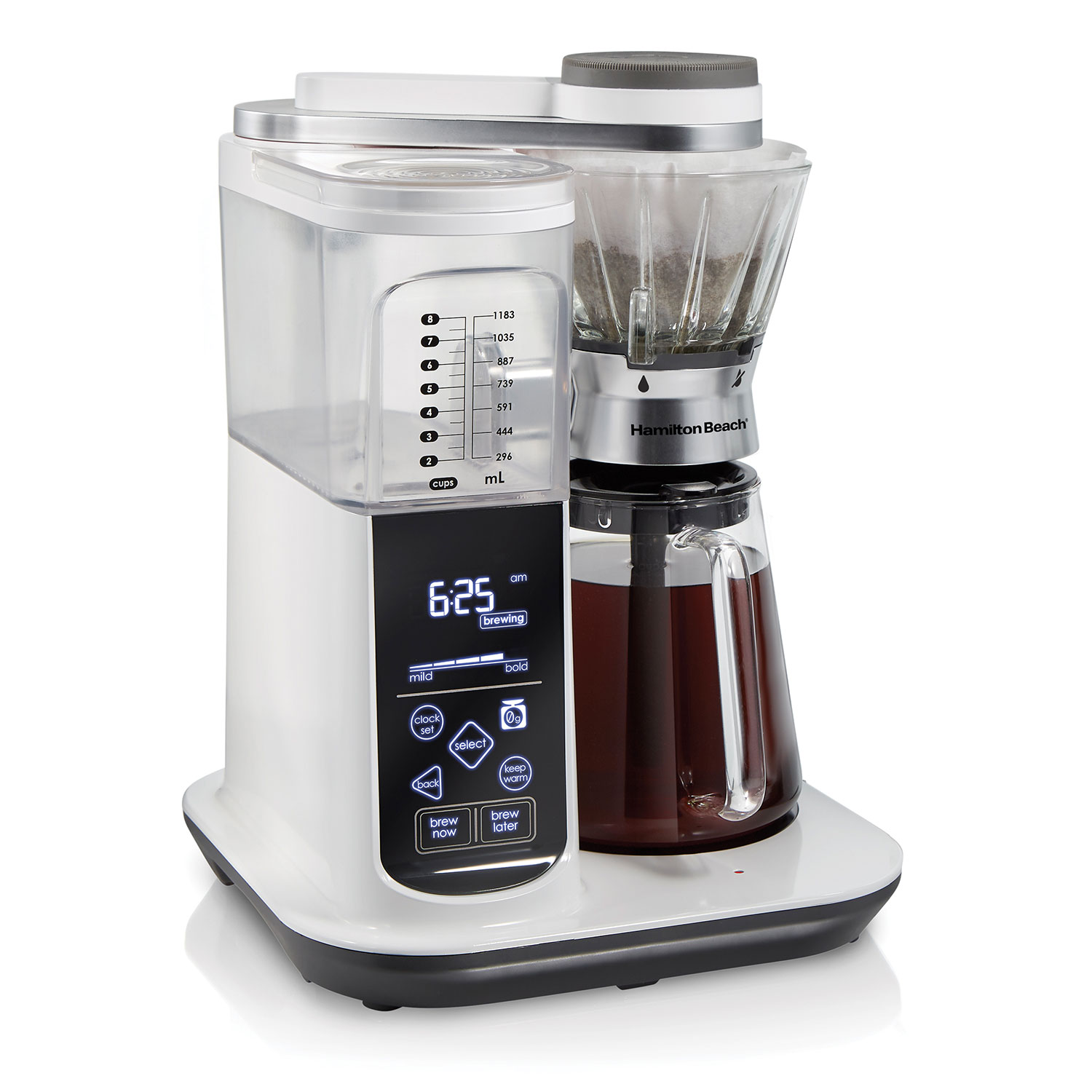
Explore this need in the finder →The Hamilton Beach 46700 is an eight-cup pour-over brewer with two distinct routines: a guided automatic cycle or a manual kettle pour. Its useful difference is not simply that it makes a pot; a scale beneath the brew basket weighs the grounds and the display guides the coffee dose, water amount, bloom, strength and heat choices. It is still a grounds-only carafe maker. It does not brew a pod, serve a single cup directly into a mug or make a dedicated Over Ice drink.
Two ways to use one brew basket
For the automatic routine, choose a batch from two to eight manufacturer cups, select a bloom cycle, one of five strengths from mild to bold, and hot or extra-hot water. The display tells you how many grams of coffee to add, then how much water to pour into the reservoir. The brewer heats and distributes the water through an oversized shower head. The machine offers a delayed start, too, but you still have to load the coffee, position the shower head above the grounds, open the drip stop, and add the amount of water the display requests. The guide says the shower head does not move itself, so it must be placed over the basket before each automated brew and left in position until the brew lights turn off.
The manual option is a real change of pace, not a menu that simulates a different automatic setting. You add grounds to the same basket, use the integrated scale to weigh them, and pour heated water from a separate kettle by hand. The guide calls for a gooseneck kettle, a 30-second bloom pause after the first wetting, then repeated 100-milliliter pours at 45-to-60-second intervals. That lets someone who already enjoys kettle technique keep the scale and carafe stand while doing the water pouring themselves.
The scale helps with coffee, not water
Do not read “integrated scale” as a water-measuring or fully automated ratio system. The scale weighs grounds in the brew basket and the display provides a suggested water amount, but the brewer does not measure the water you pour into its reservoir. The directions say all water added there will brew into the carafe and warn not to overfill it. The manual’s eight-cup maximum is 40 ounces; its table gives different ground weights for classic and robust manual pours. This makes the scale useful when repeating a dose, while leaving you responsible for measuring and filling the water.
The bloom control is another practical choice rather than proof of a specific taste outcome. Turning it on lengthens the automatic brew cycle; the manual explains that bloom as a brief wetting step. The two temperature options are labeled hot and extra hot, not a numeric temperature setting. If you want the brewer to save work while allowing a little control over strength and heat, the 46700 offers more involvement than a basic timer pot. If you want the machine to dose water from a tank and start with one button, that setup sequence may feel fussy.
Plan for a glass pot and a short warming window
Coffee collects in a borosilicate glass carafe with a mixing tube and sits on a warming plate. Keep-warm can be turned on after either automatic or manual brewing, then shuts off after two hours. That is convenient for a breakfast pot, but not the passive holding of a thermal carafe or the longer plate interval offered by some standard drip models. The exact U.S. dimensions are 14 inches high by 10.5 inches wide and 10.5 deep, so check vertical space as well as counter depth. The listed eight-cup capacity is a batch comparison, not eight travel mugs.
For filtration, the manual specifies a #4 cone paper filter, or a reusable filter only if one is included with the particular package. The current exact product page lists cone-filter samples and a water-filter pack, but does not confirm a permanent reusable brew filter in the box. The water-filter pack is not a substitute for the cone brew filter. If an included reusable filter is essential, verify the package contents before buying; this review does not assume it is there.
Who should choose the 46700?
Choose it if you want an eight-cup glass-carafe routine and value both a guided automatic pour-over and a hands-on kettle method. It is especially relevant for someone who wants the scale to help measure grounds, but is comfortable adding water and positioning the shower head. The variable two-to-eight-cup menu supports modest carafe batches, though it is not a direct-to-mug single-serving machine and does not document a one-cup cycle. It also lacks a pod path, a thermal pot, independent hot water and a cold-brew or iced-coffee setting.
If a conventional larger batch and an iced-carafe recipe matter more than manual pouring, compare the Hamilton Beach 43690J, whose manual documents a 12-cup pot and an iced setting. If you want batch coffee to stay warm without a plate underneath glass, choose a thermal-carafe model such as the FlexBrew 49929 instead; it serves a different grounds-and-pod household routine. Neither comparison is a claim that those products reproduce the 46700’s manual pour-over process.
For model-specific instructions, read the Hamilton Beach 46700 product page and the linked Use & Care guide. To check retail listings, use an exact-model search for Hamilton Beach 46700 Convenient Craft; this is a search link, not an assertion of a particular listing or ASIN.
Key details at a glance
| Coffee formats | grounds |
|---|---|
| Brew styles | hot |
| Integrated coffee grinder | No |
| Pod serving size or maximum | oz |
| Finished-coffee serving vessel | Separate carafe |
| Carafe capacity | 8 cups |
| Carafe | Glass carafe |
| How a finished batch stays warm | Electric warming plate |
| Bold/Regular strength control | Yes |
| Dedicated 1–4 cup batch setting | No |
| Separate hot-water route | No |
| Manual steam wand | No |
| Milk-frothing tool included | No |
| Milk-frothing tool heats milk | No |
| Electrical input | 1350 W |
| Voltage | 120 V |
| Documented single-cup servings or maximums | oz |
| Cold Brew with grounds | No |
| Over Ice with pods | No |
| Single-serve grounds sizes | oz |
| Documented pour-over routines | automatic / manual |
| Selectable bloom cycle | Yes |
| Brew-temperature choices | hot / extra_hot |
| Integrated scale weighs grounds | Yes |
| Strength-control choices | 5 settings |
Use the exact model’s instructions for operating limits, supplied equipment and version differences.
Sources for this assessment

Match the carafe to your coffee routine.
Choose between a warming plate and an insulated pot, then check what the exact box includes.