
Your needs, this model
Does it fit your priorities?
Do you want a fully automatic whole-bean routine instead of handling a portafilter?
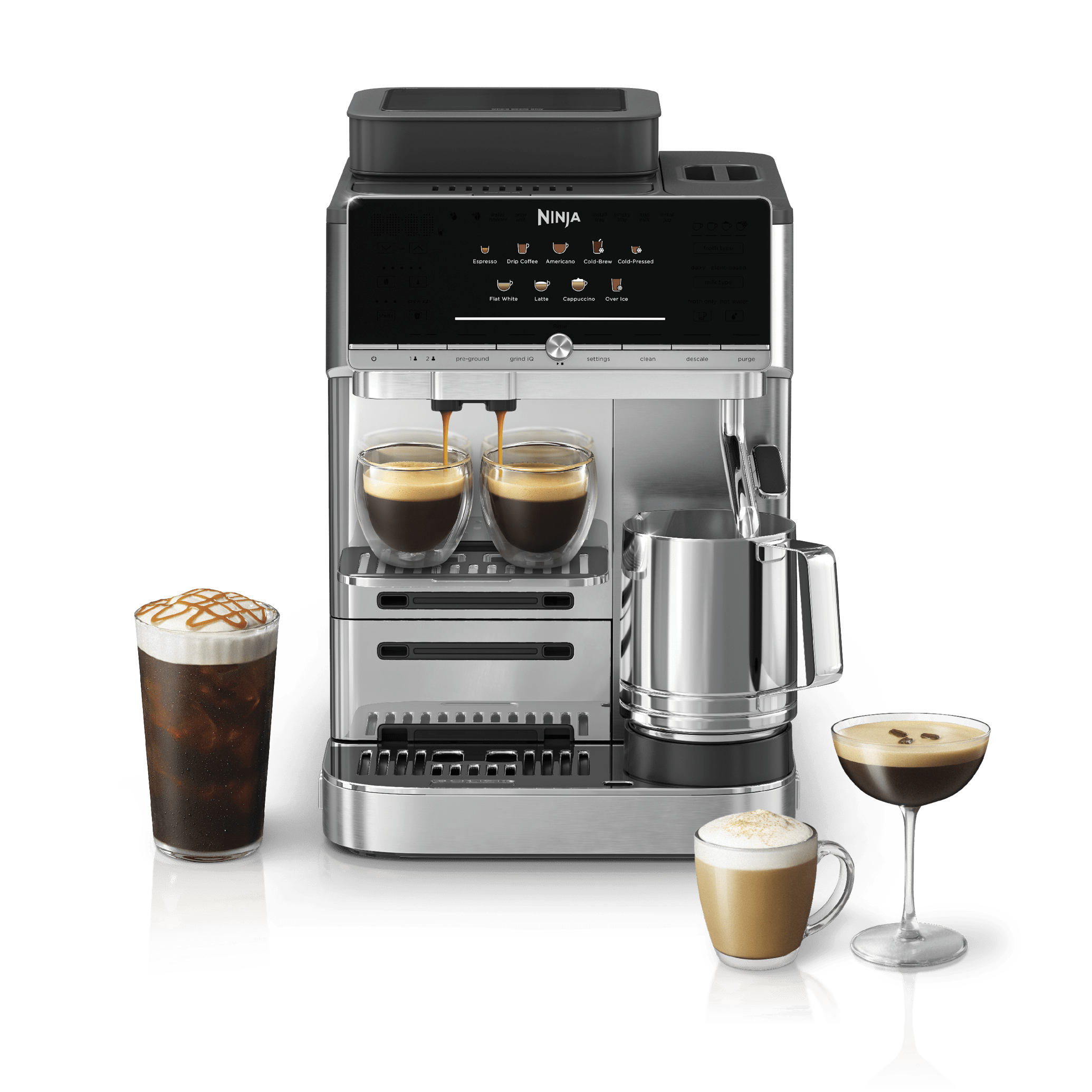
The exact page calls AE1001 fully automatic and lists Grind iQ, weight-based dosing and an integrated tamper; its quick-start uses one-touch drink selection.
Explore this need in the finder →Can the AE1001 use pre-ground coffee as well as whole beans?
Yes, but the model-labeled quick-start limits pre-ground to drip coffee up to 355 ml; it does not document pre-ground espresso.
Explore this need in the finder →Is an included batch carafe essential, or is cup-by-cup service acceptable?
The exact package list does not name a coffee carafe. The maker describes a large output program, but its included parts are not a shared table pot.
Explore this need in the finder →Do you require a second, separately swappable bean hopper?
No; the base AE1001 page lists one 250 g hopper. A second swappable hopper is the Pro AE1051 distinction.
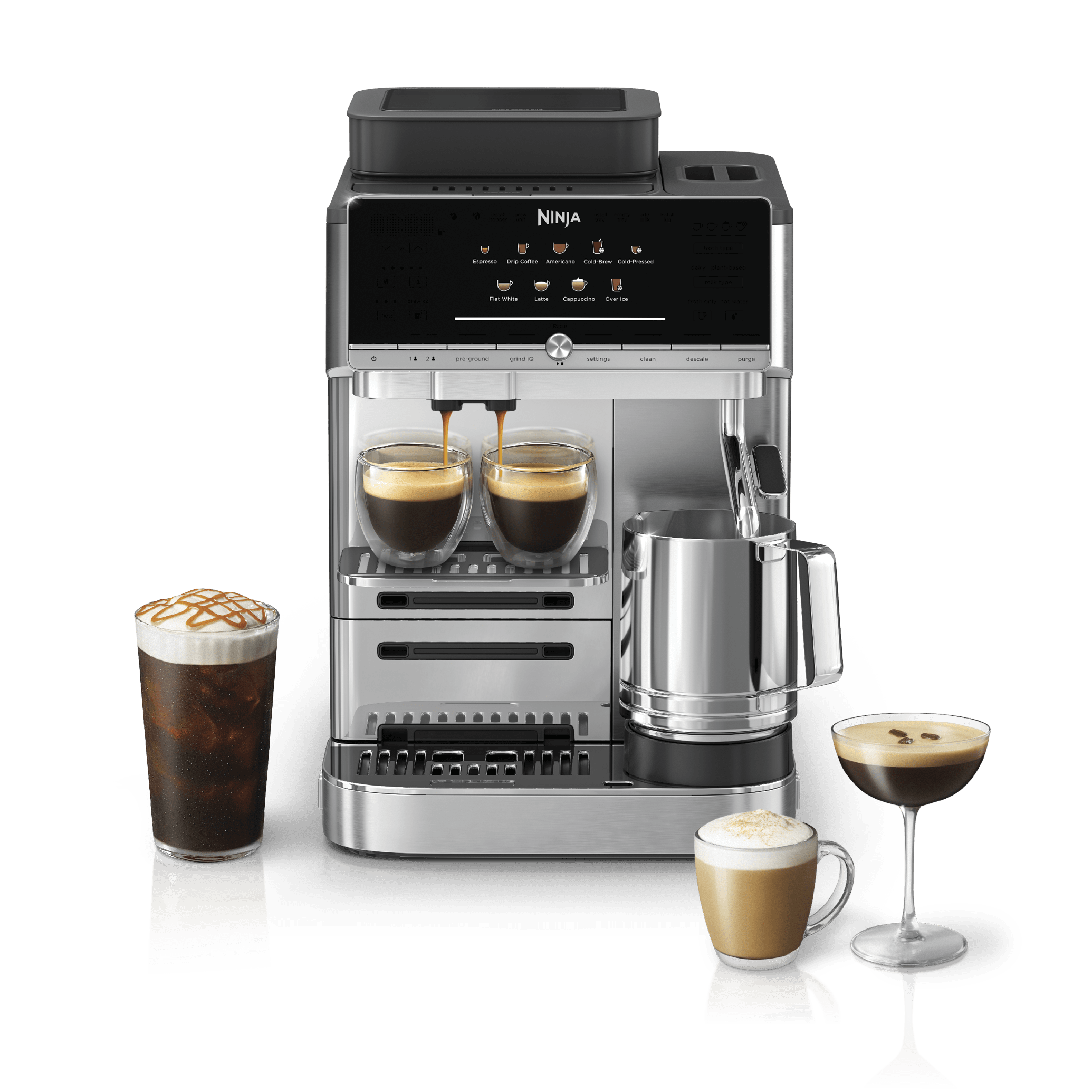
Explore this need in the finder →The Ninja AutoBarista AE1001 is for the coffee drinker who wants a bean-to-cup routine rather than a sequence of separate grinder, espresso and milk tools. The manufacturer describes a fully automatic machine with espresso, drip coffee, cold-brew and iced drink settings. It also has a separate hot-water control. That range is unusual for one countertop appliance, but it is not a conventional drip machine with a glass pot: the listed box contains no batch carafe, and it does not document a pod or capsule adapter.
What changes when the drink starts with beans?
The AE1001 pairs a stainless-steel burr grinder with 50 grind settings, automatic Grind iQ adjustment, weight-based dosing and an integrated tamper. The exact U.S. page lists ten one-touch drink presets, while its control panel also lets you adjust strength, brew temperature and drink volume for the supported coffee styles. The setup uses a 250 g hopper and 70 oz removable water reservoir. A 15-bar pump is described as tuned to nine-bar espresso pressure; those are manufacturer specifications, not a home test result.
The touchscreen/menu route makes it more hands-off than a conventional portafilter station, but don't read “automatic” as zero involvement. The model-labeled quick-start guide tells a new owner to test water hardness, prime the system and run a Grind iQ calibration on first whole-bean use. It says to recalibrate after changing beans in the same hopper. Daily startup and shutdown rinses are automatic, but the puck bin and drip tray still fill, the milk path still needs attention and you need to keep beans in the hopper.
Whole beans are the full routine; pre-ground is a narrower option
The separate pre-ground chute is useful if you occasionally have a small amount of ground coffee. The quick-start directions limit that route to drip coffee up to 355 ml (about 12 oz); volumes above that are produced by successive grind-and-brew cycles when using whole beans. That is different from a dual-format brewer that accepts pre-ground for every format. If you need pre-ground espresso, pods or a reusable single-serve grounds cup, this is not a documented fit.
For whole beans, the maker advertises authentic drip coffee and Cold Brew output up to 40 oz, with the guide distinguishing drip, Over Ice and Cold Brew from espresso drinks. That Cold Brew is a named whole-bean menu cycle; the separate pre-ground chute is documented for drip only, not as a reusable-grounds Cold Brew input. You can adjust coffee volume, strength and temperature; espresso drinks instead use shot-count controls. The guide labels its Brew Two control as suitable only for certain drinks, so it should not be treated as a promise that every preset doubles or that the machine dispenses a two-cup pot.
The fit is a countertop station, not a pot of coffee
The included 70 oz tank serves the system, but the exact package list names a milk jug, cup tray, drip tray, cleaning tools, water filter and water-hardness kit—not a glass or thermal coffee carafe. Its coffee route is therefore best understood as cup or vessel service from the spouts, including the manufacturer's large-volume drip/cold-brew claim, not a ready-to-serve pot with a warming plate. If your household wants coffee waiting in a shared carafe, a Ninja DualBrew or Cuisinart carafe brewer is the more natural kind of shortlist.
Its 17.81 × 10.68 × 15.82 in footprint is relatively wide and deep, and the 36.2 lb body is a substantial appliance to position. Leave clearance to reach the removable reservoir and hopper as well as the milk jug and spent-puck area. It uses 120 V / 60 Hz and 1,650 W, has a 53.1 in cord and a one-year limited warranty. The maker describes dishwasher-safe jug, whisk, reservoir and cup tray parts, while the brew unit, hopper, tray and puck bin are removable for hand washing. The steam wand should be wiped after frothing. The quick-start sheet establishes the setup routine but not every care interval. Use the supplied owner guide for the full cleaning and descaling schedule.
AE1001 or AutoBarista Pro?
Choose AE1001 if one hopper is enough and you want the simpler ten-preset menu. AutoBarista Pro AE1051 adds three one-touch presets, a fifth extra-thick froth setting, two swappable 340 g hoppers and an 80 oz tank. It shares the same basic footprint and overall workflow, so the Pro's practical case is the added menu and bean-hopper flexibility—not a different carafe or pod system. If you want a hands-on portafilter with separately described hot-water settings, the Luxe Café Pro ES701 follows a different, more involved preparation style. If capsules or an included batch carafe are essential, compare a pod-and-carafe hybrid instead.
In short, AE1001 suits people who want the machine to grind, dose, tamp, brew and help froth as one linked routine, and who are content to serve from cups or a chosen vessel. It is less suitable for someone who wants a simple drip pot, capsule convenience or no maintenance. No personal ownership, laboratory measurements or taste ranking is implied here; the recommendation is based on the exact product page and model-labeled quick-start instructions.
Search Amazon for Ninja AE1001 AutoBarista. The retail model code and finish matter more than a product title alone.
Key details at a glance
| Coffee formats | whole_beans / grounds |
|---|---|
| Brew styles | espresso / drip / over_ice / cold_brew / cold_pressed / hot_water |
| Integrated coffee grinder | Yes |
| Grinder mechanism | Burr |
| Grinder settings | 50 |
| Grounds brew-size choices | 4 |
| Carafe | No separate carafe |
| Permanent coffee filter included | No |
| Bold/Regular strength control | Yes |
| Dedicated 1–4 cup batch setting | No |
| Single-serve grounds cup included | No |
| Removable reservoir | 70 oz |
| Separate hot-water route | Yes |
| Manual steam wand | Yes |
| Milk-frothing tool included | Yes |
| Milk-frothing tool heats milk | Yes |
| Electrical input | 1650 W |
| Voltage | 120 V |
| Cold Brew with grounds | No |
| Over Ice with pods | No |
| One-touch drink presets | 10 |
| Bean hopper capacity | 250 g |
| Swappable bean hoppers included | No |
| Drip/Cold Brew output claim | 40 oz |
| Single-serve grounds sizes | 6 / 8 / 10 / 12 oz |
Use the exact model’s instructions for operating limits, supplied equipment and version differences.
Sources for this assessment
Match the carafe to your coffee routine.
Choose between a warming plate and an insulated pot, then check what the exact box includes.